
Three Clubs, Three Projects, One Common Thread
Updated: Aug 19

At this year's Legions AGM, presenters shared the highlights and challenges behind three building projects — Highbrook Regional Watersports Centre, St George's Rowing Club and Northshore Rowing Club. A shared story about people who saw a gap, held onto a vision and kept showing up, sometimes for decades, for the next generation of rowers.
Watch the presenters here, or read what was shared below.
Highbrook Regional Watersports Centre
Presented by Murdock Dryden, Trustee


In 2021, the Highbrook Regional Watersports Centre Trust was formed to lead a project that had already been through two decades of reports and negotiations before a shovel even went in the ground.
The seeds go back to 2000, when Auckland Rowing Club's own rebuild sparked a wider conversation about how the region could accommodate growing demand elsewhere. The following year, an Auckland Council report found the region's sports infrastructure fragmented and often duplicated - a gap that Highbrook could help close.
Between 2002 and 2004, early talks with Goodman Property and Manukau City opened the door to a possible site at Highbrook itself. Then, in 2007, the council's Auckland Regional Paddling and Rowing Infrastructure Report identified Highbrook as an opportunity for rowing and paddling infrastructure and in Murdock's words, it was "the single most important document in the whole project." Being named in that report got Highbrook on the inside of council strategy, finally bringing Local Boards and Auckland Council together as a cornerstone partner, and that mattered more than almost anything else that followed.
The build itself was too big to fund in one go. Initial cost looked to be around $10 million which was an impossible ask in the wake of the Global Financial Crisis. So the team at the time broke it into stages, tendering and funding each one before moving to the next, with visible progress on site helping make the case for the next chunk of money.
Construction ran in five stages between 2015 and 2026. Stage one (2016–2017) covered the groundwork – hardstands, retaining walls, car parks and boat ramps, largely paid for by Auckland Council's Central and Southern Local Boards. Stage two (2017–2018) delivered the pontoon for all-tide water access, funded by a grant from the Lion Foundation. Stages three and four (2018–2024) brought in water, power and wastewater services along with temporary buildings – enough to activate the site and show it was being used, this was funded through gaming trusts. The final stage since 2024 , has been the clubroom construction and ongoing fit out.
The watersport centre is due to be completed shortly, and early users include waka ama, rowing and kayaking. One of the Trust's core purposes is to reduce the geographic and financial barriers to watersport participation on the Tāmaki river for the local communities.
The finished $11 million build has come from on a mix of sources: Auckland Council, Local Boards, gaming trusts, businesses, individuals and community trusts among them, but the figures only tell half the story. Behind every stage have been volunteers, trustees and mana whenua who gave their time and expertise freely, turning a vision first raised in 2000 into a facility, some 20 to 26 years later, now finally ready to open its doors.

St George’s Rowing Club
Presented by Mike Harrison, President


At the other end of the Tāmaki River is St George's Rowing Club is a small club with a rich history. Currently home to around 70 school rowers from three schools, a small group of Club rowers and the largest masters’ groups in New Zealand with 85 members. It’s a community-based Club and proud of it — one of the oldest sporting clubs in New Zealand, founded in St George's Bay, Auckland in 1883.
They've been in their current clubrooms, at the end of Kings Road on the Tāmaki River, since 1949. Several sections of the Club were built in the early 1900s and moved onto the site. The old clubhouse had reached the end of its life. Mike Harrison described a building past the point of fixing — joinery that wouldn't open, plumbing no one would touch, floors a plumber warned people may fall through.
For decades the building replacement was explored. The building upgrade designed was modest, but significantly increases the functionality of the Club. In 2022 the project finally got off the ground because of a sizeable donation from a current member couple. The donation was conditional upon an extended lease, building consent approval and defined levels of contribution from the Club. A small committee was formed. After two years of negotiation, an agreement was reached with Council for the ground lease of 10x10x5, i.e. 25 years. Building consent, which required the design, resource consent, Geotech and other technical reports was finally approved in November 2025. Meantime the fundraising group was actively raising funds with a range of activities, this raised over $350,000 largely from the masters group. Philanthropic funding was sought; this contributed over $500,000 to the project. In all $1.1million was raised. The building project could start…
Key to the fund-raising success was the partnership with the Tāmaki Outrigger Canoe Club (TOCC), who have been storing boats outside on the Panmure Wharf reserve since 1993 without any formal recognition. In discussion between St George’s and TOCC it was clear they were mana whenua to the site and wished to have this recognised. The discussion led to collaboration and then a partnership agreement where TOCC could have their own space in the new Clubrooms and share the meeting/training area. In return, pooling membership numbers take the club, that would have reported as roughly 95% European, to one with close to 50% Māori and Pasifika representation. That shift has done more than open doors to grants and new opportunities, it's widened the age range and the options open to the club, creating a genuine mix of community on the water.
Since the building project began in December 2025, the Club has faced challenges including asbestos, swamp trees in the foundation and the main building lacking any solid foundations, this all resulted in $150,000 additional costs. Another cost is being on an "inundation zone" council reserve: a standard fire door runs under $1,000, but flood risk meant St George's needed stainless steel doors at $7,000 each, and most of the ground floor is concrete block and slab, built with flooding in mind. Past members have helped with the scaffolding and the brick laying and the building project team meets monthly to tightly manage the project. The build has absorbed the financial reserves in the budget, so as we speak the Club is actively fundraising again for the additional costs of the rebuild.
The build is expected to take eight months and be complete by November 2026. There has been a great deal of disruption, however, most of the time the build has been over winter, when there is less demand on plant. The Club has pulled together. Boats and blades were relocated, training was spread across more days, equipment moved into storage at the Panmure Yacht and Boating Club. With this build project and the council's reserve upgrade coordinated the Club should be functional ready for the crews to prepare for their competitive season.
Northshore Rowing Club: Presented by Rebecca Caroe

Northshore Rowing Club (NSRC) is actually four clubs in one, the main club, Westlake Boys High School, Westlake Girls High School and Northshore Masters, all spread across three sites in Auckland, all with different needs and different histories.
The oldest of those relationships dates back to the 1970s, when Eric Craies, coached Air Force crews out of what was then a military base at Hobsonville Point. His condition when asked to coach was that Westlake High School's first eight got to train from the base too. That informal arrangement outlasted the Air Force itself. When the base was decommissioned, Westlake's decades-long presence gave it standing to negotiate directly with the Hobsonville Land Company, and to partner with an existing sailing club on site.
The result which opened just a couple of months ago, is the Upper Waitematā Marine Centre Te Pae o Oruamokai, a striking building shared by Westlake Boys, Westlake Girls and the Hobsonville Yacht Club, with a double boat bay downstairs and a function space and commercial kitchen upstairs.
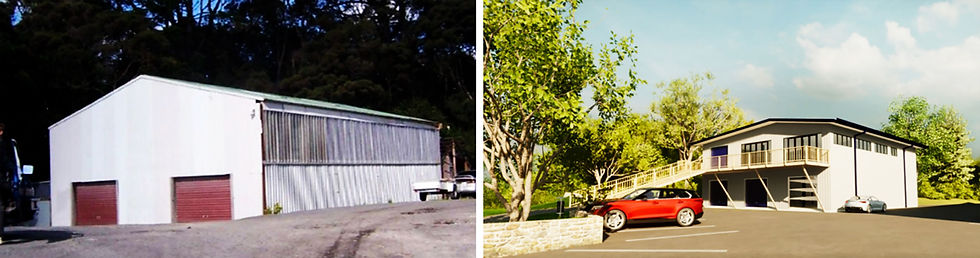
Raines Road, in Greenhithe, is currently an older tin shed with boat storage for long-distance training on the calm water of the Upper Waitematā Harbour. There are no toilets or changing rooms and the boats are stored on wooden racking. As Rebecca told the AGM, the club's recent success has depended on exactly this kind of access to the harbour, but the shed itself hasn't kept pace.
The replacement, on the same site and with a near-identical footprint, will be called the North Harbour Rowing Centre, a name chosen deliberately. Northshore Rowing Club serves a catchment well beyond the North Shore itself, drawing members and school crews from across Rodney and the Hibiscus Coast as well, and the new building is intended as a genuine regional centre of excellence rather than a single suburb's clubroom. Adding a second level will create more space for boat storage and training, let the club support more members, and make the site safer to operate.
The NSRC Building Fund is to raise $1.2 million toward the build, with donations of $1,000 or more recognised on a "Legacy Wall" of donor bricks in the new centre. A $300,000 funding gap was flagged at the recent AGM. As with the other two clubs, it is community generosity, not a single big cheque, that is expected to get it over the line.
Lake Pupuke, the third site is still actively used by both schools for learn-to-row programmes and small-boat work. It will continue to function as a rowing clubhouse, thanks to its proximity to the schools, even as the club's centre of gravity shifts toward Hobsonville and Greenhithe.


